CR-MPI report

The 2024 CR-MPI survey
Calcutta Rescue launched a data-driven approach in 2019 to assess poverty levels in the slum areas where the organization was active at the time. This resulted in the first edition of a publication, to which many professional yet unpaid volunteers from Europe and India contributed by conducting extensive data analysis and summarizing the findings in a scientific publication.
In 2024, the same MPI (Multidimensional Poverty Index) study was repeated in the same neighborhoods, with the aim of investigating whether improvements in living conditions had taken place.
The second study was carried out in collaboration with the University of Leeds. With additional support from colleagues specialized in this field, we are pleased to share the surveys' findings with readers on this page.

Download the policy brief here. This is a short and concise 6 page document that breaks down the extensive data collection and analysis report, highlighting how development work has changed.
Download the full report here. A 131-page survey report, which was produced because (volunteer) professionals in Kolkata went door-to-door asking all the questions, and volunteers compiled all this data into this final report. Many thousands of hours of work with a wonderful result.
How did multidimensional poverty change during 2019-2024?
In the 19 slums that are comparable over time, multidimensional poverty is seen to have fallen, with the proportion of multidimensionally poor residents decreasing from 70.3% in 2019 to 53.5% in 2024, by 16.8 percentage points. The bar chart to the right presents the CR-MPI values of 19 slums in 2019 and 2024. The grey bars represent the CR-MPI values in 2019, whereas the black bars represent the CR-MPI values in 2024. The slums are ordered based on their CR-MPI values in 2019.
In terms of the 17 indicators, the largest reductions in deprivations since 2019 were observed in latrine facilities, living security, antenatal care, disease knowledge, and cooking fuel. However, deprivations in nutrition, contraceptive knowledge, and access to water have slightly deteriorated over time.

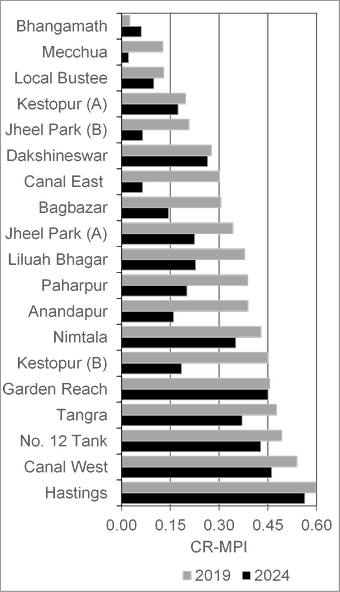
The bar chart above presents the CR-MPI values of 19 slums in 2019 and 2024. The grey bars represent the CR-MPI values in 2019, whereas the black bars represent the CR-MPI values in 2024. The slums are ordered based on their CR-MPI values in 2019.
Key messages
- Evidence-based management enables more effective and accountable use of donor funding.
- The CR-MPI approach remains relatively unique within the NGO sector.
- The CR-MPI provides not only a needs assessment and measurement of change, but also direction for future interventions and resource allocation.
Locations with some of the working areas.
- Involving the target population is essential for ensuring that interventions reflect community priorities, improve relevance, strengthen ownership, and support empowerment.
Impressions of CR's Work and people


Steun ons
IBAN: NL87 INGB 0000642340
ANBI nummer: 8160.94.032
KvK nummer: 41131886
Stichtingsnummer: S 158942